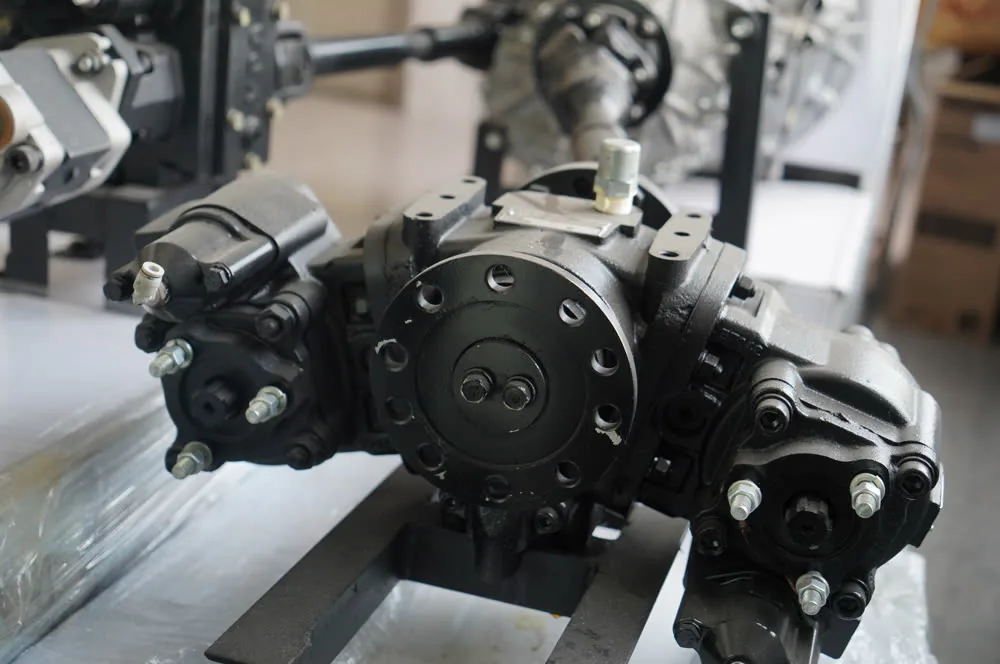
A Split Shaft PTO is a power take-off built into the truck’s driveline instead of bolted to the gearbox. It sits between the gearbox and the rear axle: the original driveshaft becomes two shorter shafts, one into the unit and one out of it, so the driveline’s power passes through it on its way to the wheels. That position is what lets it take far more power than an ordinary PTO and drive more than one piece of equipment.
How a Split Shaft PTO works
Engine power travels from the engine through the clutch and gearbox, then down the driveshaft to the rear axle. A Split Shaft sits in that line, so everything the gearbox sends towards the axle passes through it — and the gears inside it send that power to the axle, to its outputs, or to both, depending on the type.
There are two ways a Split Shaft can work, and they are different products. A stationary type disconnects the rear axle when the PTO is engaged, so the truck must be parked — the usual choice for fire pumps and vacuum or jetting trucks working on the spot. A Pump & Roll type keeps the axle driven and runs the equipment at the same time, so the truck can move while it works — used on fire trucks and water trucks that pump on the move. While moving, the gearbox has to stay in one gear, because the equipment’s speed follows the driveline.
How much more torque?
At the heavy end, many times more. A gearbox PTO is limited by one gear and the size of the opening it bolts to. A heavy-duty Split Shaft is built around the whole driveline and can pass far more power to its outputs than any gearbox PTO.
Lighter split shafts are a different story: some give their outputs about what a strong gearbox PTO would, and are chosen for the extra outputs or for the position rather than for extra torque. So check the output rating of the actual model, not just the fact that it is a split shaft — and the number that decides it is your own pump’s torque requirement. Tell us the pump and we will check it against the options.
Why a Split Shaft can run more than one pump
Two things make it possible. A split shaft has more than one output — pump-mount flanges, shaft outputs, or PTO openings of its own, depending on the type. And heavy-duty units have far more torque to share between those outputs, because they carry the whole driveline rather than one gear’s worth.
In practice one truck can drive a large water pump and the hydraulic pump for a boom at the same time, or two hydraulic circuits that would each overload a gearbox PTO. It is also the way out when the gearbox has no free PTO opening at all.
Types of Split Shaft PTO
Split Shafts all sit in the driveline, but they are not all built the same. These are the choices that separate one from another — and most real units combine several of them.
Pump-mount outputs
Hydraulic pumps bolt straight onto the outputs — no extra shafts, the most compact layout. The mounting face varies by maker: SAE flanges (B, C or D sizes) are common on American units, while others use a 3-bolt UNI pattern like the unit in the photos.
Shaft outputs
A splined or flanged output drives a shaft to equipment mounted elsewhere on the body — a large water or fire pump, a vacuum pump or a blower.
Built-in PTO openings
The gearbox carries standard PTO openings of its own, so ordinary PTOs bolt on — each with its own output, shift type and speed.
One output or several
Some units drive a single piece of equipment; others have two or more outputs, each switched from its own cab switch, and one output can often take more than one pump. Some are also sold as a bare unit with no pump output at all, and need a pump drive kit added later. Either way, the pumps themselves are usually bought separately and matched to the job.
Upright or horizontal
The same job can be done with an upright or a horizontal layout, and outputs can face the front or the rear of the truck. The space between the chassis rails and the ground clearance decide which.
Stationary or Pump & Roll
A stationary type disconnects the rear axle in PTO mode and works with the truck parked. A Pump & Roll type drives the axle and the equipment together, so the truck can move while it works — as long as the gear is not changed.
Shift type
Standard units engage with the clutch pedal down. Hot-shift units have a clutch of their own, so they engage without the pedal. Control is by air, mechanical linkage or electric, switched from the cab.
Hydrostatic drive
Made for sweepers and similar work: the equipment runs at full speed while a hydrostatic drive moves the truck along slowly, independent of the gearbox ratio.
Split Shaft vs gearbox-mounted PTO
Most PTOs are not Split Shafts. The everyday kind bolts to the side of the gearbox and taps the same path from a different place — which changes what it can do. The photos show the difference: A is bolted to the gearbox, C sits in the driveline.
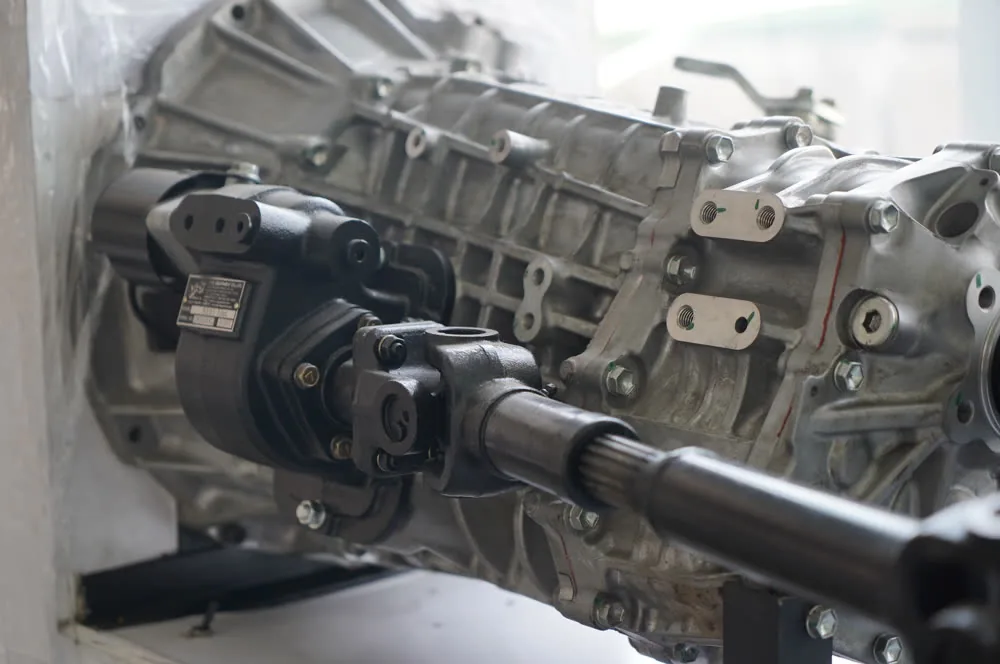
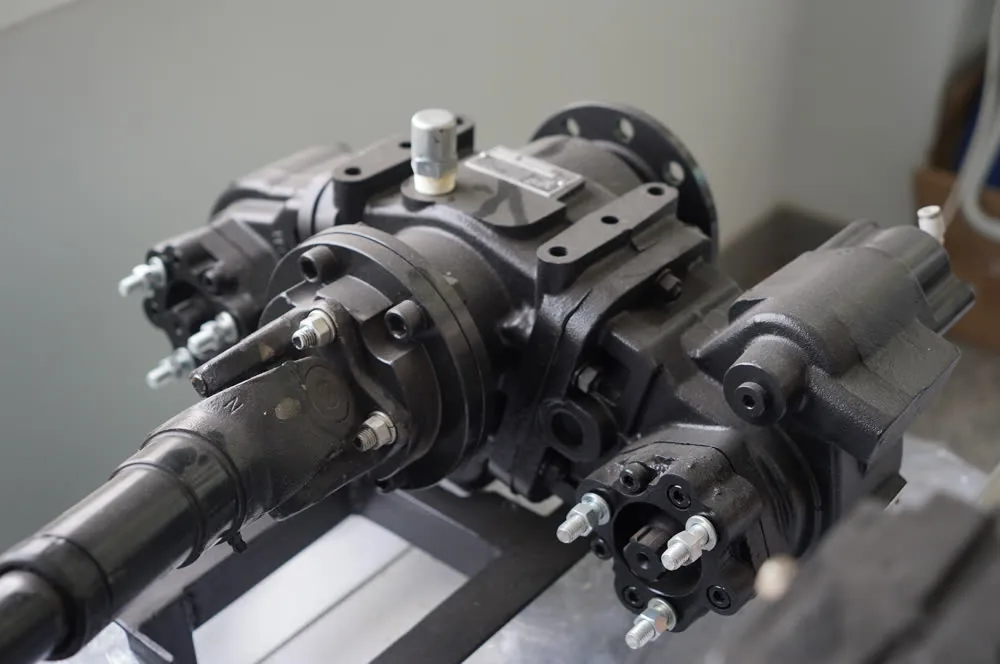
Engine power travels from the engine through the clutch and gearbox, then down the driveshaft to the rear axle. A PTO taps into that path. The question is where — and the answer changes what the PTO can do.
A gearbox-mounted PTO bolts to an opening on the gearbox housing — usually a 6- or 8-bolt aperture — and meshes with a gear inside the gearbox. It is compact, made for almost every common truck gearbox, and the most economical way to drive a hydraulic pump. It is what most people mean when they say PTO.
Its limit is built into the design: everything it delivers has to pass through that one gear and that one opening. For a tipper, a crane or a refuse compactor that is plenty. For a pump that has to take a large share of the engine’s output for hours at a time, it is not.
Side by side
| Gearbox-mounted PTO | Split Shaft PTO | |
|---|---|---|
| Where it mounts | Side of the gearbox, on a 6- or 8-bolt opening | In the driveshaft, between gearbox and rear axle |
| Power comes from | One gear inside the gearbox | The whole driveline |
| Torque it can carry | Limited by one gear and its opening | Up to many times higher — depends on the model |
| Pumps it can drive | Usually one | Two or more, at the same time |
| Works while driving | Often — depends on the gearbox and the job | Depends on the type — stationary: no; Pump & Roll: yes |
| Pump speed set by | Engine rpm and the PTO’s ratio | Engine rpm and the gear you select |
| Installation | About 2–3 hours, bolted to the gearbox | Driveshaft made into two shorter shafts; unit mounted to the chassis |
| Typical jobs | Tippers, cranes, mixers, refuse and water trucks | Fire pumps, vacuum and jetting trucks, sweepers, several pumps at once |
Which one does your job need?
Start with a gearbox-mounted PTO. For tippers, cranes, mixers and compactors it is simpler, cheaper and does the job. Look at a Split Shaft PTO when the equipment needs a large share of the engine’s power for long periods — fire pumps, vacuum and sewer-jetting trucks — when you need two or more outputs, or when your gearbox has no usable PTO opening. If the equipment must run while the truck moves, make sure the unit is a Pump & Roll type.
What fitting a Split Shaft involves
- Enough chassis length — the unit takes up a section of driveshaft, and the halves either side still need workable lengths and angles.
- Two shorter driveshafts — the original driveshaft is either cut, shortened and re-balanced, or replaced by two new shafts made to length, with the angles checked so the truck still drives smoothly.
- Mounting to the chassis — the unit hangs from the frame on its own brackets, not from the driveshaft.
- The parking brake — if it acts on the driveline it may need moving, because in PTO mode the axle is disconnected and the brake is what holds the truck.
- Automatic gearboxes — the gearbox has to be locked in a range while the PTO works, so it cannot shift under load.
- How it engages — standard units are engaged with the driveline stopped and the clutch pedal down; hot-shift units have their own clutch and do not need the pedal.