
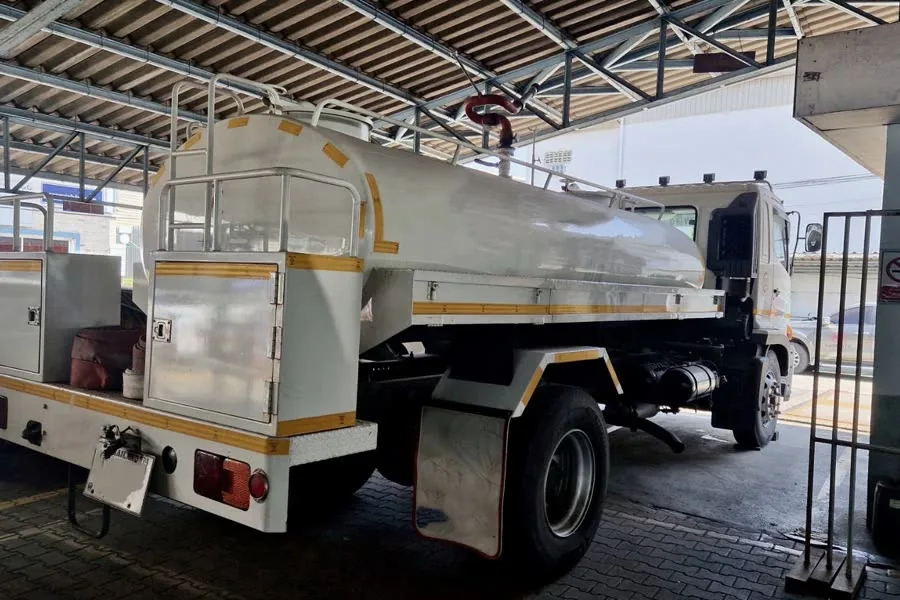
On a water truck the tank only carries the water — the pump is what does the work. It fills the tank from a canal or a hydrant, washes the road, waters a construction site or feeds a fire hose, and on most trucks it is driven by the engine through a PTO. Choosing it well comes down to a few questions about what the truck will actually do, and a few details about the truck it is going on.
Why water trucks use a centrifugal pump
The hydraulic pumps that tip dump bodies and swing cranes are gear or piston pumps, built to push oil against very high pressure. Water is a different job: there is a lot of it, it is thin, and it rarely has to be pushed very hard. A centrifugal pump suits it — a spinning impeller flings the water outward and out through the discharge, moving large volumes with a simple, compact pump. That is why the pump on a water truck looks nothing like the pump on a tipper, even when the same kind of PTO drives both.
Why it needs a speed-up gear
A centrifugal pump only performs at high shaft speed; turn it slowly and the water barely moves. A PTO output turns far slower than that, so a step-up gear between the PTO and the impeller multiplies the speed. The VPS GR-3, for example, is geared 1:4.09 from the PTO and is designed to run at 3,900–4,000 RPM.
This is why the PTO and the engine speed matter as much as the pump itself. If the pump never reaches its working speed, the truck feels weak no matter how good the pump is — and the fix drivers reach for, revving the engine harder, costs fuel and wears everything faster. Tell your supplier which PTO the truck has, or order the pump and the PTO as one matched set.
Decide what the truck is for first
A centrifugal pump trades pressure for flow: the more water it lets out, the less pressure it can hold, and the other way round. So the right pump depends on the main job:
- Hauling and filling — the priority is volume, so the tank fills and empties quickly. Pressure matters less.
- Road washing and dust suppression — a steady flow through spray bars at moderate pressure, often for hours at a time, so the pump and the PTO both run under continuous duty.
- Fire fighting and water cannons — pressure and reach matter, because the water has to travel through a long hose or a monitor nozzle and still arrive with force.
If one truck has to do all three, choose for the hardest job, and talk it through with your supplier before you order.
Self-priming — and what it does not mean
Many water trucks draw from ponds, canals and tanks that sit below the pump. A standard centrifugal pump cannot pull water up an empty suction hose on its own and has to be primed by hand; a self-priming pump can, because it holds water in its casing and clears the air out of the suction hose each time it starts.
Self-priming is not dry-running. The casing still has to be filled with water before the very first start, and the pump must never be left turning with no water in it. A dry pump heats up quickly, and the first part it destroys is the mechanical seal.
What to check before you order
- Your gearbox and PTO — the truck brand, model and gearbox decide which PTO fits and how fast its output turns.
- Direction of rotation — a PTO output turns one way or the other depending on the gearbox, and the pump has to match. The GR-3 is made in both left- and right-hand rotation.
- Inlet and outlet size — match them to the hoses, spray bars and fittings you already use.
- Where the water comes from — how far below the pump the water usually sits, and how long the suction hose is.
- Where the pump will be mounted — the space on the chassis, and a driveshaft route from the PTO that stays straight and well supported.
Keeping it working
- Always fit a strainer on the suction hose — sand and stones that get past it wear the impeller.
- After pumping dirty or brackish water, run clean water through the pump so sediment does not settle in the casing.
- Do not run the pump for long against a closed valve. With nowhere to go, the water churns inside the casing and heats up.
- Watch the seal for drips, and grease the driveshaft from the PTO at the same time as your regular PTO checks.